


MEDIA RELEASE
15 January 2026
National fails its own fairness test
Greyhound Racing New Zealand says National’s legislation banning commercial greyhound racing fails standards of fairness and rigour set by the Party during and after the 2023 election campaign.
Christopher Luxon claimed his Government would make “detailed, constructive and intellectually rigorous solutions”, and govern for a nation that “celebrates fairness”. Those commitments were echoed by his fellow National MPs.
However, political commentators and the industry say the draft legislation currently before Parliament to end commercial greyhound racing contradicts those commitments. Greyhound Racing New Zealand (GRNZ) CEO Edward Rennell is challenging National MPs, as they gather for their caucus retreat, to try and reconcile their values with their policies. He says the proposed ban is a politically motivated decision that lacks both just cause and an evidential foundation.
“It’s a major betrayal by National of its pledge to govern with fairness and evidence. “The Bill doesn’t meet long-established norms of evidence based policy making, it fails the welfare of greyhounds, and it unjustly dismantles a regulated closely-monitored industry.”
Under the draft legislation, greyhound racing will not be banned, only wagering on New Zealand greyhound races will be banned. Amateur greyhound racing is allowed but without regulations and protections.
The Bill also permits the continued importation of overseas greyhound races for betting and broadcast - providing millions-of-dollars of revenue the Minister for Racing says will be used to support New Zealand’s horse racing industry.
Rennell says the legislation is neither intellectually rigorous nor fair. He says there is no evidence that greyhound racing failed to meet government-mandated welfare standards, yet participants face unemployment and uncompensated losses of millions of dollars in assets.
“How is it fair to abolish jobs and provide no compensation to those affected? “How is it fair to redirect revenue generated from greyhound racing to horse racing? “This is a Government whose words don't match its actions - National says it values animal welfare yet they’re bringing back live exports by sea - it’s hard to know what they stand for.”
Rennell says the Government will never be able to produce evidence to justify the ban but that if it is to proceed, significant amendments are required to reduce the harm and injustice the legislation imposes.
“At a minimum, the Bill must prioritise the welfare of greyhounds, allow rehoming to be managed by experts over a longer time-frame, retain GRNZ and affiliated clubs as legal entities, and define fair and targeted compensation and support for all affected workers and animals.”
GRNZ welcomes appearing before the Primary Production Select Committee, its first opportunity to be consulted on a ban that will rip $159m and 1,054 jobs from the economy unjustly.
The Bill is at select committee for public feedback with a report due by 13 March 2026. The ban on commercial greyhound racing would take effect from August 2026. ENDS
For interviews please contact Edward Rennell edward@grnz.co.nz 021 407 596
MEDIA RELEASE
24 November 2025
SPCA trades integrity for political deals - betraying the trust of New Zealanders
When the SPCA lobbied then-Deputy Prime Minister and Minister for Racing, Winston Peters, to ban greyhound racing, the SPCA knew that Mr Peters might be concerned the SPCA would push for a ban on horse racing as well.
To ease those fears, the SPCA wrote to Mr Peters assuring him it would not call for a ban on horse racing, despite the rate of race-related deaths in horse racing being consistently higher than that of greyhound racing.
In doing so, the organisation traded its principles for political favour - sacrificing meaningful protections for horses to advance its stance on greyhounds.
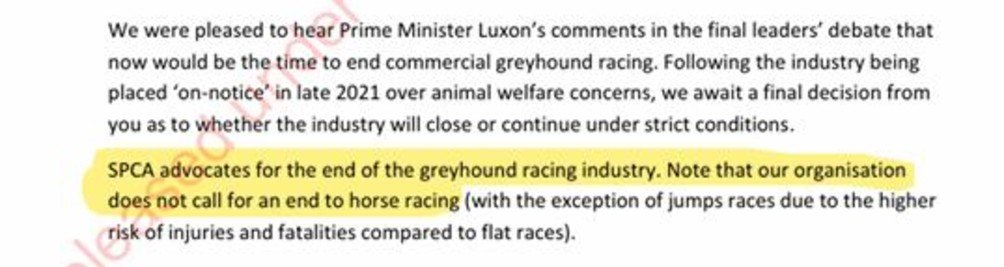
Below is an excerpt of the letter SPCA sent to Minister Peters on 30 November 2023 signed by CEO, Todd Westwood and its Chief Scientific Advisor, Arnja Dale, made public under the Official Information Act.
“We were pleased to hear Prime Minister Luxon’s comments in the final leaders’ debate that now would be the time to end commercial greyhound racing. Following the industry being placed ‘on-notice’ in late 2021 over animal welfare concerns, we await a final decision from you as to whether the industry will close or continue under strict conditions.
SPCA advocates for the end of the greyhound racing industry. Note that our organisation does not call for an end to horse racing (with the exception of jumps races due to the higher risk of injuries and fatalities compared to flat races).”
SPCA would have New Zealanders believe it is an organisation free of speciesism. It is not. It is quick to criticise the greyhound racing industry, but is silent on the higher number of race-related deaths in horse racing.
It leverages neglected animals to fund the salaries of its expanding corporate headcount.
It hides the true scale of the companion animal crisis by refusing to disclose how many animals it euthanises each year - estimated to be many thousands.
This lack of transparency is especially troubling given the millions of taxpayer dollars SPCA receives to enforce the Animal Welfare Act 1999 through its Inspectorate - an area experts say it does with limited effectiveness.
Meanwhile, small independent shelters and rescue groups all over the country carry out the real work of caring for companion animals, without the funding SPCA receives.
In light of this, New Zealanders are urged to withhold donations to SPCA and demand transparency.
Share this message with everyone who values fairness, credibility, and trust.
Submissions on the bill to end greyhound racing are now open. Tell the Government you oppose the ban, the takeover of a lawful incorporated society, and the hypocrisy of banning local racing while continuing to import Australian races for New Zealanders to bet on.
https://bills.parliament.nz/.../a47d0be3-d1e7-4e52-1917...
Submissions close 9 January 2026.
More information on the process and background information can be found here: https://www.grnz.co.nz/News/3397/Latest-info-here
MEDIA RELEASE
11 November 2025
Bill to end greyhound racing a hollow political stunt that destroys jobs and fails animals.
Minister for Racing, Winston Peters, today introduced a bill in Parliament that will end greyhound racing by dissolving Greyhound Racing New Zealand (GRNZ) — erasing a $159 million contribution to the economy and abolishing more than 1,000 jobs.
“The draft legislation confirms this is a Government that’s given up on fair treatment of New Zealanders to satisfy a Prime Minister who invented a policy under pressure in an election debate,” says GRNZ Chief Executive Edward Rennell.
“If the decision to end greyhound racing really is about animal welfare, then it must go much further and ban betting on overseas greyhound racing, anything less is just a stunt ”
The bill allows betting on Australian greyhound races to continue unimpeded— an industry with over 46,000 races a year, generating more than $238 million turnover annually in New Zealand alone.
GRNZ strongly opposes the ban, but says that if the Government insists on proceeding, it must do so with impeccable fairness with compensation and support for industry participants.
“It’s one thing to lose your job and lifetime investments due to market forces - it is wholly unacceptable to incur these losses due to ill-conceived government policy. It’s not only unjust, but deeply callous,” Rennell says.
“This bill means the Luxon-led Government will make another thousand people jobless, hand bureaucrats control over rehoming 1,500 dogs, and give itself unprecedented powers to take control of a well-run, financially sound incorporated society.”
Since taking office, Winston Peters has not once communicated with GRNZ, declining or ignoring multiple requests for a meeting.
“Instead, he’s resorted to name-calling in the media, publicly referring to our people as sinners when dismissing genuine questions on compensation to support our people,” says Rennell.
GRNZ says the bill will actually weaken greyhound welfare — removing protections, allowing rehomed dogs to be euthanised without cause, and relying on vague wording that could see dogs placed in unsafe or unregulated environments.
“For a Government claiming to take animal welfare seriously, the bill is a joke,” Rennell says.
“New Zealanders deserve more than a string of policy failures, they deserve leadership that respects people and acts with integrity rather than undermining the rule of law and trampling the rights of workers and communities.” ENDS
For inquiries and interviews please contact GRNZ CEO edward@grnz.co.nz 021 407 596
MEDIA RELEASE
29 October 2025
Government chooses “fun and freedoms” over animal welfare
Comments made by Finance Minister, Nicola Willis, on RNZ this morning confirm the Luxon-led Government has little interest in animal welfare or the views of New Zealanders.
Asked if she would support a ban or restrictions to fireworks, Willis said although fireworks “terrorise animals” she doesn't want the government to take away “our fun and freedoms.”
“I’d be sad to lose that part of New Zealand culture,” Willis said, reminiscing of double happies and skyrockets.
Petitions calling for a ban on the private sale and use of fireworks have collected more than 90 thousand signatures, reflecting a desire among New Zealanders to put an end to the distress, disruption, gruesome injuries and death fireworks cause animals.
But National MP, Greg Fleming, who was presented with a petition, told RNZ that "there's no appetite whatsoever from the Government's agenda for looking at this".
"It's well outside of our batting lane with everything focused on economic growth and controlling government expenditure, et cetera," Fleming said.
Greyhound Racing New Zealand (GRNZ) criticises the Government for being hollow in its words and actions on both animal welfare and economic growth, saying the bill to end greyhound racing in NZ will weaken animal protections, wipe 159 million dollars off the economy and put more than a thousand people out of work.
“There couldn't be a worse time to advance a policy that puts people out of jobs,” says GRNZ CEO Edward Rennell.
“This is not a government that cares for animals or its people.”
In a letter to the Finance Minister Mr Rennell implored Nicola Willis to consider deferring policies that cost jobs until the economy is stronger, employment prospects improve, and business confidence has been restored.
That letter remains unanswered. ENDS
For interviews or more information please contact GRNZ CEO Edward Rennell edward@grnz.co.nz 021 407 596
MEDIA RELEASE
14 October 2025
Government Moves To Takeover Incorporated Societies – Your Organisation Could Be Next
The New Zealand Government is on the verge of presenting legislation to Parliament that will forcibly dissolve a fully compliant incorporated society—Greyhound Racing New Zealand (GRNZ)—and take control of its assets.
Commenting on the Government’s draft legislation now available online, CEO Edward Rennell warns that this same model may be used to shut down other industries and societies in future.
“This is not about greyhound racing anymore, this is about raw political power overriding legal protections. It is a direct attack on the rights of all 23,000+ incorporated societies across New Zealand.
“If it can happen to GRNZ, it can happen to any society—your club, your charity, your union, this is not democracy. It’s dangerous,” says Rennell.
Under the Racing Industry (Closure of Greyhound Racing Industry) Amendment Bill, Parliament will:
Bypass the Incorporated Societies Act and ignore GRNZ’s lawful standing.
Force the dissolution of GRNZ and its affiliated clubs, without wrongdoing.
Confiscate all remaining assets (and millions in cash) transferring them to a state agency and horse racing codes.
Claim the right to do it again, to other sectors, as outlined in the Ministerial Advisory Committee’s own terms of reference.
Rennell says this sets a chilling precedent:
“This Bill sends a clear message from Christopher Luxon’s Government: your organisation exists at our discretion—not under the law.
“Your society’s constitution and legal protections mean nothing if the Government decides you're no longer welcome. There is no legal recourse. No court process. Just political will.”
If this Bill passes:
Every incorporated society becomes vulnerable to political interference.
Assets can be forcibly taken, even when the society is compliant and operational.
The rule of law is replaced by ministerial discretion.
GRNZ believes the closure of greyhound racing is unjustified, but that if it is to proceed, it must be implemented with impeccable fairness to both greyhounds and their people, especially as Minister Peters’ own advisors have drawn attention to the significant wellbeing risks to participants.
“We predicted the Government would excuse its extraordinarily aggressive takeover as necessary to pay for rehoming greyhounds, but what is glaring is the total lack of plans and provisions for those left without assets and employment prospects,” says Rennell.
“This isn't about animal welfare, this is an asset grab without cause, dressed up as policy.”
New Zealanders gamble $238 million annually on more than 46,000 Australian greyhound races annually. GRNZ insists that if betting on greyhound races in New Zealand is deemed unacceptable, then the bill should also prohibit betting on all greyhound racing.
“The Government’s bill allows for New Zealanders to continue betting on overseas greyhound races, even though other racing jurisdictions' welfare standards are no better than ours,” says Rennell.
“This is completely illogical, and makes any ban on New Zealand greyhound racing utterly meaningless. This topsy turvy policy only serves to make more than a thousand people jobless."
GRNZ urges every society in New Zealand to:
Alert your board, members, and community immediately.
Make a submission to the Select Committee opposing the bill, once submissions open.
Join forces with other societies to defend your collective rights.
Contact your MP and demand answers. ENDS
For media inquiries and interviews please contact Edward@grnz.co.nz or phone 021407 596
See draft legislation here
Media Release
10 October 2025
GRNZ Publishes Address in Bid to Meet Minister Winston Peters
Greyhound Racing New Zealand (GRNZ) is publicly sharing its head office address and the personal phone number of its CEO in a bold effort to secure a long-requested meeting with Racing Minister Winston Peters.
GRNZ CEO Edward Rennell says repeated attempts to engage with Minister Peters have been ignored, despite the organisation’s willingness to meet at Parliament, on track, or anywhere convenient.
“We hope that by sharing our address, it might increase our chances of having a visit from Minister Winston Peters, who has so far declined every request to meet with us,” says Rennell.
The GRNZ head office is located on Jackson Street in Petone, just a short train ride from Parliament. Alongside the address, Rennell is also making his mobile number public: 021 407 596.
“Nothing we have tried so far has secured us any time with the man who is legislating more than 1,000 jobs out of existence. If publishing our address helps prompt a conversation, then it’s worth it.”
Rennell says GRNZ is seeking a fair opportunity to present up-to-date data that he believes was overlooked in the Government’s decision to shut down the industry. The Minister announced in December 2024 that greyhound racing would be banned on animal welfare grounds.
GRNZ argues that the decision is inconsistent, pointing out that the Government continues to rely on millions in revenue from Australian greyhound betting — while shutting down the sport domestically.
“We’d ask the Minister to explain the hypocrisy of banning greyhound racing here while continuing to profit from it overseas,” says Rennell.
“I believe this decision also has major implications for the equine codes that ultimately will impact on the viability of racing in New Zealand. As the Minister for Racing, Mr Peters needs to be aware of these issues.”
Despite Minister Peters meeting with the SPCA to discuss the ban he has never consulted with GRNZ or directly engaged with greyhound racing participants. Rennell says the Minister has made disparaging remarks in the media about people involved in the industry — comments he describes as hurtful and damaging.
“I’m hoping the Minister sees my number or address and thinks, ‘Hey, I’ll pick up the phone and have a chat.’ That’s all we’re asking for, a conversation.”
GRNZ continues to oppose the closure of the industry and urges the Government to focus on more pressing, large-scale animal welfare crises where real leadership is needed.ENDS
For media enquiries or interviews, please contact:
GRNZ CEO - Edward Rennell edward@grnz.co.nz - 021 407 596
Media Release
8 October 2025
Dramatic Drop in Greyhound Injuries
Greyhound Racing New Zealand (GRNZ) welcomes news the rate of serious greyhound raceday injuries has fallen dramatically, following years of work to evolve welfare-focused initiatives — including world-leading 7-dog race fields with a vacant Box 1.
The injury rates are verified by the Racing Integrity Board (RIB). Acting on behalf of the Government, the RIB ensures compliance with high standards of integrity, animal welfare, and professionalism within the racing industry. Audits conducted by the RIB demonstrate that GRNZ consistently satisfies or exceeds the metrics required of it.
In the three months ending 30 September 2025, the most severe injury category—Category F injuries, which include raceday euthanasias—fell to 1.6 per 1,000 starts. This is less than half the rate of 4.4 per 1,000 starts recorded in the six months to 31 January 2025, marking a significant improvement since the Government announced the industry's closure in December 2024.
Edward Rennell, Chief Executive of GRNZ, says the results are no accident:
“We’ve worked hard, long before closure was on the cards, to evolve the support systems and race configurations in line with increasing expertise and understanding. We monitor injuries more comprehensively than any other animal code in New Zealand. This is a remarkable achievement that reflects years of thoughtful, science-led work to make racing safer.”
All injury categories have shown downward trends, thanks to sustained efforts across track design, veterinary oversight, participant education, migration to straight track, and race day management. GRNZ’s pioneering 7-dog format, with a vacant inside box, has proven to be the most effective configuration for reducing congestion and risk on the track.
GRNZ’s welfare advances come at a time when other animal welfare issues are worsening nationwide. Auckland Council has reported a crisis of unwanted dogs, with overflowing shelters and an increase in euthanasias to manage capacity. SPCA continues to cite rising demand and pressures on its services but refuses to release its own euthanasia data, leaving a significant gap in transparency around New Zealand’s companion animal welfare.
“If Christopher Luxon’s Government truly cared about animal welfare, it would prioritise evidence-based initiatives that address real, large-scale problems. Greyhound racing is one of the most highly monitored and traceable animal codes in the country — far ahead of others, including horse racing, in terms of transparency,” says Rennell.
“Unlike big animal charities, we don’t euthanise animals to create capacity.”
While Minister for Racing Winston Peters has said the greyhound racing ban reflects the Government’s concern for animal welfare, GRNZ believes it will do nothing to address the country’s companion animal welfare crises.
Working animals play important roles in customs, law enforcement, military service, farming, hunting, and entertainment. Greyhounds, like racehorses, have long had a place in sporting culture. But unlike some codes, greyhound racing has demonstrated its capacity to evolve — quickly and meaningfully.
“We’ve embraced reform and built systems that prioritise welfare without compromising the integrity of the sport,” Rennell says.
“This injury reduction milestone proves that meaningful change is possible — when there’s a genuine commitment to continuous improvement. It is a travesty that the Government did not give this due consideration when making the decision to close the industry without consulting GRNZ on the true facts.” ENDS
For interviews please contact GRNZ CEO Edward Rennell - 021 407 596 or email edward@grnz.co.nz
NZ Greyhounds: The Best Cared For Dogs
All greyhounds are microchipped.
Neo-natal mortality is much lower than other breeds: Research shows others to be 100% to 800% worse.
Not subject to elective-euthanasia as pups.
Greyhounds are not brachycephalic. According to SPCA, “Brachycephalic breeds have captured the hearts of animal lovers worldwide, but this love is blind to the often severe health issues that compromise these animals’ wellbeing and force them to suffer.”
Litters remain with their mothers much longer than other domestic breeds.
One of the reasons for their reputation as great pets is the care and attention they receive throughout their life in a racing kennel.
They are well fed, exercised and medically looked after - including the highest vaccination rates in the world.
Zero cases of obesity: According to SPCA “... as pets get bigger, their lives get shorter. Obesity can shorten a dog’s life expectancy by 25%. Pet obesity can lead to serious health problems, such as diabetes, heart disease, arthritis, kidney disease, respiratory distress, high blood pressure, and cancers.”
Greyhounds get to do what they love. (Although those that choose not to race -simply don't. There is no means to coax them if they do not want to.)
Racing greyhounds are inspected by a vet more often than any other animal.
Racing greyhounds are more documented than any other animal, even the most superficial racing injury is publicly recorded.
The number of litters a female can whelp is restricted.
Greyhounds must be specifically registered for breeding, those with genetic defects will not be registered.
De-sexing is mandatory for all pets leaving the Industry.
* Other issues NOT associated with Greyhounds:
Boxers: PD Insurance NZ says they are prone to hip dysplasia, heart problems, and cancer.
Cocker Spaniels: PD Insurance NZ says they are prone to a wide range of health issues, including ear infections, eye problems, and certain genetic conditions.
Dachshunds: PD Insurance NZ says they are known for back issues due to their long spines and short legs, as well as hip dysplasia, skin allergies, and dental problems.
German Shepherds: PD Insurance NZ says they are at risk for hip and elbow dysplasia, Progressive Retinal Atrophy (PRA), and other eye problems.
Golden Retrievers: PD Insurance NZ says they can be predisposed to hip and elbow dysplasia, heart conditions, and certain types of cancer.
Labrador Retrievers: PD Insurance NZ says they are prone to joint problems, obesity, heart diseases, cataracts, and ear infections.
* Source: https://www.pdinsurance.co.nz/blogs/tag/purebred-dogs/
Media Release
20 August 2025
Government’s plan to seize greyhounds assets, force people out of work and gift millions to horse racing laid bare
The Government’s decision to proceed with its plan for closure of greyhound racing has been described as ‘heartless and brutal’ treatment of ordinary Kiwis.
The recommendations adopted by Cabinet include:
Closure of an incorporated society and seizure of in excess $15m in Greyhound Racing New Zealand and assets.
No compensation for the 1,054 full time employees who lose their jobs.
Continuation of taking $223m ($48m profit) in bets annually on Australian greyhounds.
After the dogs are rehomed, all GRNZ assets and future profit from Australian greyhound betting will be transferred to horse racing.
Chief Executive Edward Rennell said:
“It’s a disdainful approach to lawmaking and a particularly brutal way to treat people. Their heartless disregard for destroying thousands of livelihoods of regional Kiwis to satisfy an urban elite and reward horse racing is frankly depressing.
“The truth is our people are honest, reasonable and look after their dogs. We meet all welfare requirements the Government makes of us, endorsed by their own Racing Integrity Board.
“They're up against a Government that just doesn’t care about the loss of a 150-year-old sport, lifestyles, and jobs. The Minister still won’t communicate or meet with us. We had to learn from news media interviews that this government won’t compensate the people whose incomes and investments they’re taking away.
“Instead, they will shut down an incorporated society that hasn’t done anything illegal, seize $15m of the sport’s hard-earned money, permit broadcasts of 48,000 Australian greyhound races and take $223m in bets. This shows the ban is not about welfare. Approximately $50m in annual betting revenue from Australian greyhounds will be gifted to the horse racing codes.
“This represents yet another rushed and misinformed decision from the Government — one of 87 they made in their first year, according to an analysis of Treasury reports.”
“We predicted in June the Government will claim this money will be used for rehoming dogs, which is of course the right thing to do. The release of the Ministerial Advisory Committee report confirms our suspicions of a deal being made to benefit horse racing at our expense.
“It’s a deeply cynical and hypocritical move by this government.”
Mr Rennell said the Government decided to shut down the sport without weighing the costs, not just on people, but on economic activity.
“The losses will be keenly felt in the provinces, particularly Waikato, the Central North Island and Canterbury, where greyhound racing is strongest. $160m may be a small proportion of GDP, but it’s a lot of money when the nation's regions can least afford it.
“The Government is reinstating live animal exports by sea, a trade that has fallen out of favour with most countries. It generates $300m annually so clearly, money matters if welfare standards can be met unless its greyhound racing.”
ENDS
For further information contact:
Liam Constable – 029 200 9842
About GRNZ
Greyhound Racing New Zealand is the governing body for greyhound racing in New Zealand and provides governance, support and assistance to the affiliated clubs in the sport of greyhound racing.
The decision to end greyhound racing has significant economic and social consequences. The sport provides 1,054 full-time equivalent jobs and contributed $159.2 million to the economy in FY23.
The Government announced on 10 December 2024, an intention to legislate to ban greyhound racing in New Zealand from 31 July 2026.
Visit www.grnz.co.nz for more information.
Media Release
10 August 2025
New Homes for 697 Great Mates
Greyhound Racing New Zealand’s (GRNZ) rehoming program Great Mates has placed a record 697 greyhounds in loving homes in the past 12 months with the help of its trusted and approved network of partners - Greyhounds As Pets, Nightrave Greyhounds, May Hounds, and Kiwkiwi Hounds.
“It's quite an achievement especially in a cost-of-living crisis with 16,000 job losses across the country in the same 12-month period,” says GRNZ’s Welfare Strategy and Operations Manager Darrin Williams.
“Our adoption numbers reaffirm our commitment to ensuring every greyhound has a great life from birth to retirement and beyond,” says Williams. “We meet or exceed every requirement set by the government's watchdog (Racing Integrity Board), and our excellent traceability reinforces that commitment.”
The latest numbers build on consistent progress of GRNZ’s Great Mates rehoming program with 673 total adoptions in FY 23/24 and 481 adoptions in FY 22/23.
“There was some needless scaremongering that GRNZ’s greyhound rehoming efforts would slow when the government’s intention to ban greyhound racing was announced but the numbers show Great Mates continues to be effective,” says Williams.
“Caring for animals takes time and money and we are grateful to all the generous people who are sharing their homes with greyhounds, but New Zealanders are finding it tough, so adopting an animal is a really big deal.”
Equine codes are not immune to the challenges of rehoming either with Harness Racing New Zealand launching a Rehoming Rewards Scheme that incentivises rehoming bloodstock in exchange for Prezzy Cards. Twenty horses rehomed equals a Prezzy Card of $150 value, $300 value if 35 horses are rehomed, and $500 value for rehoming 50 horses. The scheme notes “horses that are euthanised, returned to their original owner or come back to you for resale won’t count towards your total.”
Recent media reports from Councils and animal shelters report of a drop in their adoption rates that they say is driven by financial pressure and desperation.
“It's clear that many people are struggling to look after their dogs properly,” Auckland Council’s Animal Management Manager Elly Waitoa was quoted as saying in a council media release.
“The sheer number of dogs going unclaimed has sadly meant more dogs have been euthanised than in previous years,” she said.
SPCA reports a decline in dog adoptions for the past 12 months while demand for support is greater than what the organisation can provide. Speaking with RNZ’s Checkpoint, its General Manager of Animal Services Dr Corey Regnerus-Kell says they struggle to get the message across as to what they can and can't do.
“We don't help the owned healthy animals,” Regnerus-Kell says.
“The SPCA is not here to be a rehoming service for everybody who doesn't want an animal anymore.”
Rehoming 697 greyhounds is a responsibility GRNZ takes seriously, and enormous care is taken to ensure each dog is well prepared for their new home. Every greyhound that is rehomed through Great Mates is microchipped, desexed, vaccinated, socialised, dental and vet-checked, behaviourally assessed, and council registered.
“Our greyhounds have been loved since birth. They are happy, healthy and make perfect pets.” Williams says.
GRNZ continues to encourage responsible animal lovers looking to adopt a greyhound as a pet to visit Great Mates to browse adoption profiles through its trusted and approved partners. /ENDS
For media inquiries or interviews, contact:
Darrin Williams, Welfare Strategy and Operations Manager: darrin@grnz.co.nz
Website:
Watch the Great Mates TVC:
There's a Great Mate for Everyone!
About GRNZ
Greyhound Racing New Zealand is the governing body for greyhound racing in New Zealand and provides governance, support and assistance to the affiliated clubs in the sport of greyhound racing.
The decision to end greyhound racing has significant economic and social consequences. The sport provides 1,054 full-time equivalent jobs and contributed $159.2 million to the economy in FY23.
The Government announced on 10 December 2024, an intention to legislate to ban greyhound racing in New Zealand from 31 July 2026.
Greyhound Racing New Zealand has applied, through its Counsel to the High Court, for a Judicial Review of the Government’s decision to ban greyhound racing.
Visit www.grnz.co.nz for more information.
Media Release
30 June 2025
Forced closure of greyhound racing could cost taxpayers $40m
Greyhound Racing New Zealand (GRNZ) has estimated that the Government’s decision to close greyhound racing could cost the taxpayer at least an additional $40m, primarily due to the cost of looking after greyhounds for up to three years while they wait to be rehomed.
When the decision was made, the Government’s misguided belief was that the greyhound population would be rehomed by 31 July 2026 when racing would finish.
Latest projections provided by GRNZ to the Government is that 1,500 greyhounds will still need to be rehomed following the closure of racing.
GRNZ’s sophisticated rehoming programme has been able to maximise demand and successfully rehome greyhounds as pets at about 650 a year. Given current demand it will take two to three years to rehome all 1,500 greyhounds after the sport’s closure.
Current rehoming costs are met by GRNZ, funded by revenue from racing. Last year it spent $8.3m to rehome 673 greyhounds. There will be no racing after July 2026, so rehoming costs post-closure will have to be funded from alternative sources.
The $40m+ includes housing and veterinary costs for the greyhounds while they wait to get into the GRNZ rehoming programme, the costs of preparation and pet training, and the costs of finding homes and adopting them into these homes. This estimate is based on analysis of GRNZ’s current rehoming costs.
Additional costs to the taxpayer include the Ministerial Advisory Committee and Government officials. Also not included in the calculations is compensation for the assets and losses incurred on closure by racing participants.
Greyhound Racing New Zealand CEO Edward Rennell said:
“Greyhound racing treats its dogs better than most other working animals, while thousands of pets are neglected through the community.
“This additional $40m cost further highlights the Government’s cavalier approach and flawed decision making. Taxpayers are set to lose the industry’s $159m contribution to the economy and could now face an additional unbudgeted cost of $40m to close a sport that doesn't need to close.
“Taking shortcuts is not an option. GRNZ will continue to stand up for the sake of our participants and the greyhounds in having this flawed decision over-turned and common sense applied.”
/Ends
For further information contact:
Liam Constable – 029 200 9842
About GRNZ
Greyhound Racing New Zealand is the governing body for greyhound racing in New Zealand and provides governance, support and assistance to the affiliated clubs in the sport of greyhound racing.
The decision to end greyhound racing has significant economic and social consequences. The sport provides 1,054 full-time equivalent jobs and contributed $159.2 million to the economy in FY23.
The Government announced on 10 December 2024, an intention to legislate to ban greyhound racing in New Zealand from 31 July 2026.
Greyhound Racing New Zealand has applied, through its Counsel to the High Court, for a Judicial Review of the Government’s decision to ban greyhound racing.
Visit www.grnz.co.nz, lovegreyhounds for more information.
Media Release
23 June 2025
New analysis details Government annual gift of $119m to multinational gambling company
Greyhound Racing New Zealand has released new analysis detailing the extent to which the Government is financially supporting a multinational gambling giant.
It comes as the Government is expected this week to pass the Racing Industry Amendment Bill into law, creating a digital monopoly on gambling for Entain.
The analysis, prepared by an independent consultant, details the financial help required for Entain to meet its funding guarantee of $150m per year to the racing industry.
The funding guarantee, combined with a guarantee to retain approximately 450 TAB staff until June 2025, were set under the terms of the agreement when the TAB’s betting business was outsourced to Entain in 2023.
The analysis estimates in dollar terms the value of the Government’s support to bail out Entain so it can limit its losses in meeting the terms of its deal until 2029.
The passage of legislation to block New Zealanders from gambling offshore will boost Entain annual revenues by at least $75m per year.
The retention of gambling on Australian greyhounds after the ban comes into effect, will preserve Entain gross betting revenues of approximately $44m per year.
Without these actions by the Government, Entain would be faced with an estimated revenue deficit of $26m per year.
Greyhound Racing New Zealand CEO Edward Rennell said:
“The Government has chosen to bail out a multinational gambling company at the expense of ordinary Kiwis.
“It will shamelessly pass laws and create digital monopolies so Entain can meet its funding guarantees and obligations to private shareholders.
“Entain won’t need to compete to win new revenue as it was brought in to do. It will be gifted it by banning Kiwis from using non-Entain betting providers and retaining gambling on Australian greyhound racing.
“The decision to keep taking money from Australian greyhound races, but strip thousands of regional Kiwis of their livelihoods and passion, is depressingly cynical and hypocritical.
“Gross income of $44 million dollars each year will now be sliced up between the Government, Entain and the equine codes and not go to the thousands of trainers, owners, and breeders involved in greyhound racing.
“It’s a reverse Robin Hood. The Government is taking money from the provinces to save face on a bad deal and keep the money flowing into Entain, thoroughbred and harness racing.”
/Ends
For further information contact:
Liam Constable – 029 200 9842
EDITORS NOTES
Timeline of Entain – TAB deal:
March 2023: TAB and Entain agreed to enter a strategic partnership agreement where TAB has delegated its betting and wagering functions to Entain.
May 2023: The partnership was approved by then Racing Minister Labour’s Kieran McAnulty, outsourcing TAB’s monopoly betting operation to Entain for 25 years, a UK-listed multinational. 50% revenue share between Entain and the TAB.
May 2023: TAB sought a variation to its authorisation of its arrangements with Tabcorp to reflect strategic partnership with Entain.
June 2023: The partnership officially started on June 1, 2023.
Entain Guarantees under the terms of sale:
Entain provided TAB $150 million upfront a with a guaranteed $150 million for the first five years.
$10 million sponsorship for racing carnivals.
On passage of the Racing Amendment bill into law: $100 million payment from Entain, $80 million to be shared between thoroughbred and harness racing
Entain committed to no forced redundancies for first 24 months of the agreement, due to expire this month (June 2025).
Book value of Entain’s TAB licence assets, if the Racing Amendment legislation goes through:
According to Entain’s March 2025 annual report, the estimated value of the New Zealand TAB licence assets was $2.7 billion NZD, including the potential introduction of the legislation.
About GRNZ
Greyhound Racing New Zealand is the governing body for greyhound racing in New Zealand and provides governance, support and assistance to the affiliated clubs in the sport of greyhound racing.
The decision to end greyhound racing has significant economic and social consequences. The sport provides 1,054 full-time equivalent jobs and contributed $159.2 million to the economy in FY23.
The Government announced on 10 December 2024, an intention to legislate to ban greyhound racing in New Zealand from 31 July 2026.
Visit www.grnz.co.nz for more information.
Media Release
16 June 2025
Government requisition plans for Greyhound money revealed
Greyhound Racing New Zealand said today that the Government will enter unprecedented territory
if it requisitions the organisation’s savings fund (currently $16m), built up over decades, as part of its
intended ban of the sport.
GRNZ is an Incorporated Society, with funds held on behalf of participants in the sport.
Governments can only forcibly close and appropriate funds of an Incorporated Society for financial
misconduct, insolvency or failure to submit returns.
GRNZ has operated impeccably and complied with all requests made of it. Therefore, the
Government will need to pass a remarkable new law to close a Society that has done nothing illegal.
The Government would need to declare what happens to the Society’s funds. It has been
suspiciously silent on the matter to date.
GRNZ CEO Edward Rennell said a grab for money rightly owned by the sport and its participants
would be contemptible.
“The Government will execute the sport on trumped up charges, and make us pay for the gallows
and grave,” Rennell said.
“It is a real low point; the first Government to fabricate a new law to close an Incorporated Society
that is totally compliant with all laws and standards. It’s a cavalier approach to law, justice and
democracy.
“The Government is grinding its heel into our people by taking their money as well as their sport.
“Those funds were built up over decades by generations of sport participants. It belongs to them,”
Edward Rennell said.
Rennell predicts the Government would excuse the extraordinary theft as necessary to pay for
rehoming greyhounds, but he says that the high cost arises from the Government’s ban, and
insistence on a close-down faster than greyhounds can be rehomed, requiring long-term kenneling
while they wait.
Rennell said the ban was unjustified, so at least should be carried out with impeccable fairness. Any
ban must be cost-neutral, where the sport is wound down gradually, using profits and savings to
cover costs and compensate participants for loss of assets.
/ends
For further information contact:
Liam Constable – 029 200 9842

Media Release
26 May 2025
Greyhounds starts judicial review proceedings
Greyhound Racing New Zealand (GRNZ) has today applied, through its Counsel to the High Court, for a Judicial Review of the Government’s decision to ban greyhound racing from 31 July 2026.
The statement of claim made to the Court says the decision broke fundamental rules of law, being inadequately informed, prepared and consulted on. There were only a few short steps from the Minister for Racing seeking a report in June 2024 on banning the sport, to the Cabinet deciding to do so in December 2024.
The Cabinet paper produced by the Department of Internal Affairs (DIA) focused on animal welfare but was selective in its use of reports from the Racing Integrity Board (RIB) and included no information from the National Animal Welfare Advisory Committee (NAWAC). For example, an RIB November 2024 report stated that GRNZ met welfare standards, often better than other animal sports or greyhound racing worldwide, but this information was left out of the DIA report and Cabinet paper.
GRNZ’s application says there was a duty, promise and expectation to consult with GRNZ on the decision which never happened, despite a history of constructive engagement on animal welfare.
GRNZ CEO Edward Rennell said “the organisation had decided on a judicial review to expose the Government’s cavalier attitude to policymaking adversely impacting the livelihoods of thousands.
“This was a Cabinet paper from public officials who had made up their minds, for a Prime Minister who had made up his mind and stated it publicly.
“The Government took its decision too lightly and too quickly, without due care and due diligence. It was a rushed and inadequate Cabinet paper.
“This is an injustice to greyhound breeders, owners, trainers and all other industry participants, as well as a dereliction of duty to New Zealanders.
“Decisions that impact the lives and livelihoods of people must be extremely well articulated and evidenced.
This decision was not, highlighting an emerging pattern of short-cutting in policymaking. New Zealand deserves better.” Edward Rennell said.
Case explainer
The GRNZ statement of claim under the Judicial Review Procedure Act 2016:
• The essence of the GRNZ case is that the way the Cabinet decision to ban Greyhound racing was reached and the decision itself broke many fundamental rules of administrative law.
• It is rare to challenge a Cabinet decision, but the decision-making process was so inadequate and erroneous that it warrants judicial intervention.
• It clarifies that the Cabinet decision was a ‘reviewable decision’ under the Judicial Review Procedure Act 2016.
• The first cause of action was the failure to consult.
GRNZ says consultation is a legal duty that arose from being promised to Greyhound Racing, and because of the hugely significant implications to the detriment of many
hundreds of hardworking New Zealanders. The Department of Internal Affairs officials said no decision would be made without Greyhound Racing being consulted – but it did not
happen.
• The second cause of action is legitimate expectation.
A legitimate expectation about a certain process can be established by what has been said or done by a decision maker. GRNZ says DIA’s course of conduct since 2021 created a
legitimate expectation that the industry would be able to make submissions on any proposed ban.
• The third point is that the process broke all the rules about procedural fairness.
Decisionmakers must act reasonably to ensure the process undertaken is fair and not a foregone conclusion. That has not happened here.
• The fourth and fifth causes of action deal with the failure to make relevant considerations.
Either the Minister was unaware of the development of the Cabinet paper and the background circumstances, or the Minister knew exactly what was going on and was
instrumental in its sign-off and presentation.
The fourth cause of action says that if the Minister was unaware, then the officials failed by not bringing to the Minister’s attention certain key relevant considerations
The fifth cause of action proceeds on the basis that the Minister did know what was going on.
• Interim Relief.
GRNZ is applying for ‘interim relief’ – a Court order to stop the Crown working on the ban (via the Ministerial Advisory Committee) while the judicial review is undertaken. No further
steps to give effect to the ban should be taken unless and until the Court has had an opportunity of scrutinising the claim.
/Ends
About GRNZ
Greyhound Racing New Zealand is the governing body for greyhound racing in New Zealand and provides governance, support and assistance to the affiliated clubs in the sport of greyhound racing.
The decision to end greyhound racing has significant economic and social consequences. The sport provides 1,054 full-time equivalent jobs and contributed $159.2 million to the economy in FY23.
The Government announced on 10 December 2024, an intention to legislate to ban greyhound racing in New Zealand from 31 July 2026.